

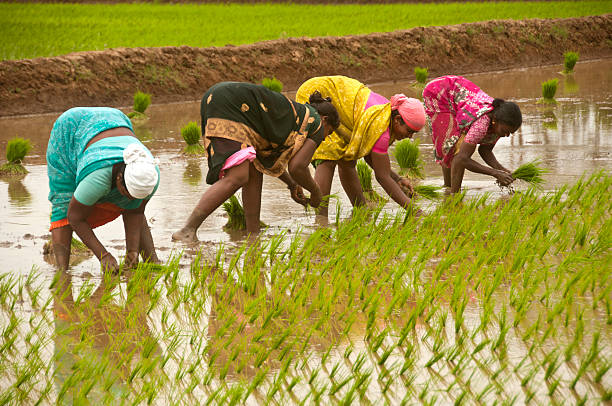
Sustainable agriculture is one that produces abundant food without depleting the earth’s resources or polluting its environment. It is agriculture that follows the principles of nature to develop systems for raising crops and livestock that are, like nature, self-sustaining. Sustainable agriculture is also the agriculture of social values, one whose success is indistinguishable from vibrant rural communities, rich lives for families on the farms, and wholesome food for everyone. But in the first decade of the 21st Century, sustainable agriculture, as a set of commonly accepted practices or a model farm economy, is still in its infancy—more than an idea, but only just.
Although sustainability in agriculture is tied to broader issues of the global economy, declining petroleum reserves, and domestic food security, its midwives were not government policy makers but small farmers, environmentalists, and a persistent cadre of agricultural scientists. These people saw the devastation that late 20th-Century farming was causing to the very means of agricultural production—the water and soil—and so began a search for better ways to farm, an exploration that continues to this day.
Conventional 20th-Century agriculture took industrial production as its model, and vertically-integrated agri-business’ was the result. The industrial approach, coupled with substantial government subsidies, made food abundant and cheap in the United States. But farms are biological systems, not mechanical ones, and they exist in a social context in ways that manufacturing plants do not. Through its emphasis on high production, the industrial model has degraded soil and water, reduced the biodiversity that is a key element to food security, increased our dependence on imported oil, and driven more and more acres into the hands of fewer and fewer “farmers,” crippling rural communities.
In recent decades, sustainable farmers and researchers around the world have responded to the extractive industrial model with ecology-based approaches, variously called natural, organic, low-input, alternative, regenerative, holistic, Biodynamic, biointensive, and biological farming systems. All of them, representing thousands of farms, have contributed to our understanding of what sustainable systems are, and each of them shares a vision of “farming with nature,” an agroecology that promotes biodiversity, recycles plant nutrients, protects soil from erosion, conserves and protects water, uses minimum tillage, and integrates crop and livestock enterprises on the farm.
But no matter how elegant the system or how accomplished the farmer, no agriculture is sustainable if it’s not also profitable, able to provide a healthy family income and a good quality of life. Sustainable practices lend themselves to smaller, family-scale farms. These farms, in turn, tend to find their best niches in local markets, within local food systems, often selling directly to consumers. As alternatives to industrial agriculture evolve, so must their markets and the farmers who serve them. Creating and serving new markets remains one of the key challenges for sustainable agriculture.
Created By :- Banirupa Patra