

Since 2014, when devastating floods ravaged most parts of Kashmir, 54-year-old Ghulam Nabi Ganaie of Pulwama’s Lethpora village has never had a profitable saffron harvest. Lack of irrigation facilities and prolonged dry weather saw his annual yield of saffron on 15 kanals of land (1.87 acres) fall by half.
The losses, however, didn’t push him to switch to apple farming unlike many farmers in his village. Ganaie knew the superiority of the saffron he grew in his fields would fetch good returns.
Now, for the first time in seven years, his saffron yield has grown by nearly 48 percent. “Last year I harvested 400 grams of saffron. Post 2014, we would witness untimely rainfall coupled with lack of adequate facilities. My annual yield, which was more than a kilogram back in the 1990s, had been reduced to just 250 grams,” he says.
Not just Ganaie, similar results in the annual yield were being witnessed by the more than 400 saffron farmers in his village.
The saffron yield in 2021 has touched a two-decade high of 15.04 metric tonnes (MT), courtesy the Rs 400 crore National Saffron Mission and Geographic Indication tagging by the government.
Saffron cultivation is an important contributor to the Union Territory’s agriculture sector, which is the main occupation of around 80 percent of its population.
Saffron land stretches to 3,715 hectares and is cultivated mainly in three districts: Pulwama, Srinagar and Budgam. Pampore, a township in Pulwama district with around 3,200 hectares of land under cultivation, produces the most saffron in the Valley.
Srinagar and Budgam cultivate saffron on 165 and 300 hectares, respectively; Kishtwar is the only district in the Jammu division to grow the spice on 50 hectares of land.
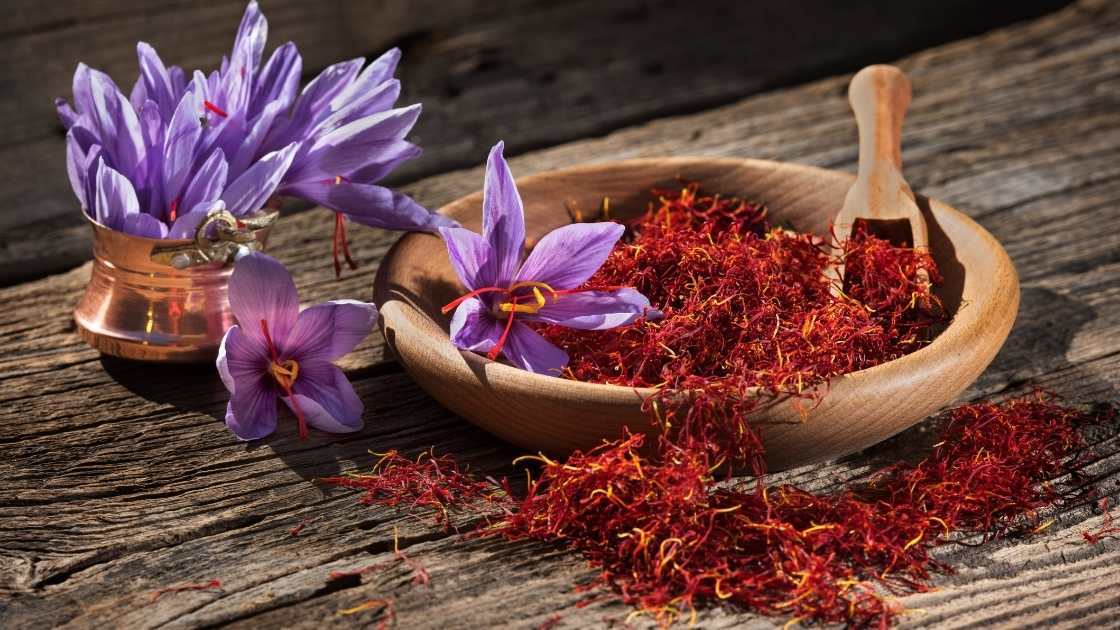
Saffron cultivation entails much hard work and patience — when the purple harvest arrives in autumn, the flowers are plucked and the crimson red stigma removed and dried for days until it shrinks to the size of a slender thread. One stigma of saffron weighs about 2 mg and on average each flower has three stigmata.
Kashmiri saffron is of superior quality because of the higher concentration of crocin, a carotenoid pigment that gives saffron its colour and medicinal value. Its crocin content is 8.72 percent compared to the Iranian variant’s 6.82 percent, which gives it a darker colour and enhanced medicinal value.
Given that the autumn and winter season witnessed a good amount of rainfall, growers expect a bigger harvest in the coming year.
“We are hopeful to see an even better yield in the saffron crop this year,” says Abdul Majeed Wani, a saffron grower and president of the All J&K Saffron Growers Development Cooperative Marketing Association.
The last time Kashmir recorded an annual yield of 15 MT saffron was in 1996, when the average yield was 2.80 kg per hectare while the cultivated area was 5,707 hectares.
Till 2010, saffron production declined by 35 percent (10.40MT) as the area under cultivation shrank to a mere 3,715 hectares.
Realising that the costliest spice of the world was getting extinct from Kashmir, the Ministry of Agriculture implemented the Rs 400.11 crore National Saffron Mission.
While the cultivated land couldn’t be revived under the mission, however, the government was successful in increasing the production of saffron in Kashmir.
In the first year of the Mission’s implementation, production stood at 10.03 MT, with an average yield of 2.69 kg per hectare.
Under the Mission, Department of Agriculture–Kashmir developed infrastructure, including 124 borewells and 126 sprinkler systems, and introduced modern integrated methods of farming.
By 2020, production increased to 13.36 MT with an average yield of 4.92 kg per hectare.
“Farmers would mostly rely on traditional methods like use of ploughs and manual de-weeding. The department convinced farmers to shift to scientific farming, which helped us double our production,” says Sajad Ahmad, a saffron grower from Pulwama.
Saffron growers association President Wani says the use of borewells and sprinklers will enhance production. “The irrigation component is not complete yet as the borewells have not been put to use. Water scarcity is the main problem, which, if resolved, will certainly double our production,” he says.
Department of Agriculture Kashmir Director Chaudhary Mohammad Iqbal says that the department extended services like interculture operations and inter-nutrient management in saffron cultivation under the mission to boost production.