

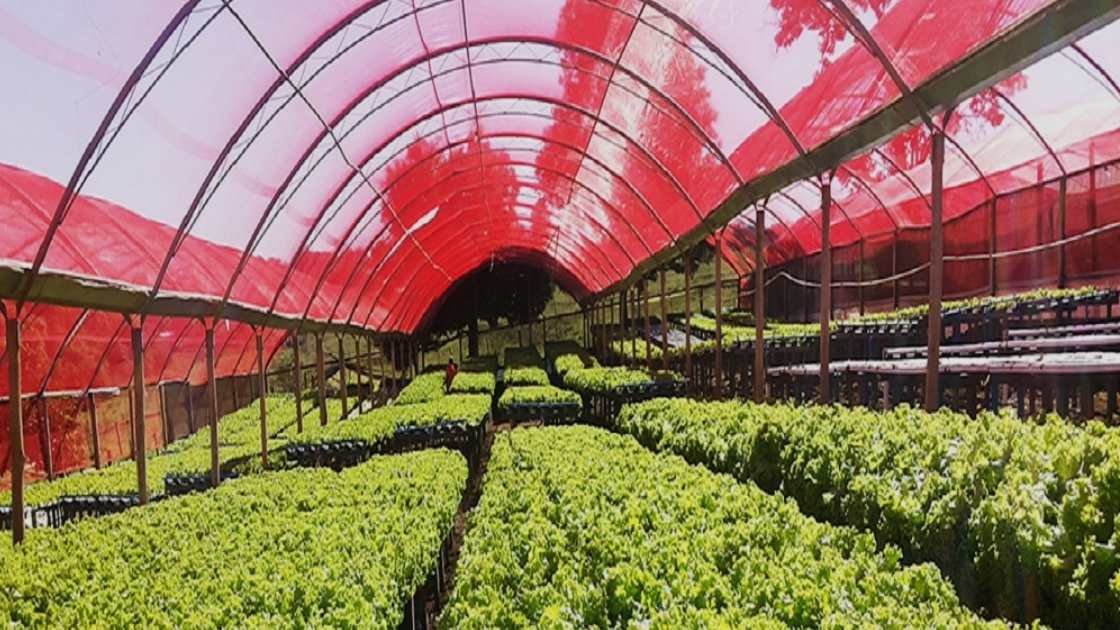
For generations, humans have used greenhouses to help plants thrive outside of suitable environments. As it turns out, instead of greenhouses, we might be better off constructing red houses. The red spectrum of light encourages plant leaves to produce more chlorophyll, and an Australian agricultural start-up is using this fundamental science to create thick red films to cover greenhouses in order to improve plant productivity beyond what sunlight or greenhouses can provide.
Scientists from the Universities of New South Wales and Western Sydney created LLEAF, or Luminescent-Light Emitting Agriculture Films.
They manufacture and are currently testing a variety of films to increase agricultural yields, each tailored to a specific type of plant.
“Our luminescent light-emitting agricultural film, LLEAF,” says company co-founder Dr. Alex Soeriyadi, “is meant to ‘supercharge’ natural sunlight by transforming the natural light into a light spectrum that is more favorable for plant development.” “Our studies show that there is potential to boost output, better plant cycle, and harvest management.”
LLEAF 620 is a low-red spectrum light that boosts photosynthesis and increases output in most plants, however, LLEAF 590 is the ideal choice for aquatic plants where light penetration through water is necessary for enhanced growth rate.
Far-red spectrum light is better for fruiting trees and flowers, hence LLEAF supplies two separate films, one for production and one for growth, that reach the 700-nanometer range of the light spectrum.
The films are constructed of unique dyes that absorb and scatter photons from the green spectrum of light before re-emitting them as a red light to boost plant photosynthesis.
They reduce the amount of light that the plants cannot utilize, and they diffuse the light that they can use more uniformly and in a way that reduces shadows.
The plastics are incredibly resilient and may be readily adapted to any existing greenhouse structure.
The dyes are completely biodegradable and carbon-based, with no metals, and the plastic sheeting is completely recyclable.