

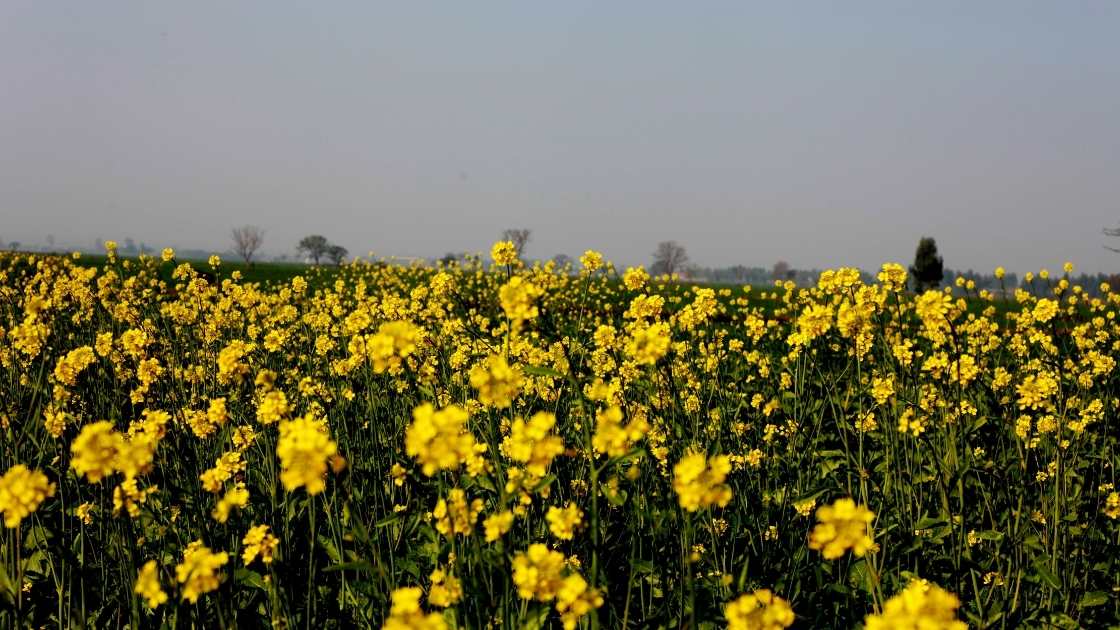
Basant Ram Sharma, a farmer from Rajasthan’s Bharatpur district who planted mustard on 6.5 hectares this season, has been visiting the mustard mandi at this country’s trading hub to compare mandi rates.
While Sharma is just beginning to harvest his mustard crop, he is also keeping a close eye on the conflict in Ukraine. The outcome of the battle will affect farmers like Sharma, who must decide whether to sell crops in the mandis or store them for a few more months in anticipation of higher prices.
While current mustard mandi prices are about Rs.6400 per quintal, which is much more than the Minimum support price (MSP) of Rs.5050 per quintal for the current season, farmers like Sharma are holding on to their stocks even though the peak arrivals time is set to commence from March 15.
“I will wait till mandi prices reach Rs.7500 per quintal and then sell my harvest,” Sharma stated. He anticipates a harvest of around 30 quintal per hectare which he will store for the time being and bring into mandi gradually.
Despite an expected bumper mustard output of 11.45 million tonnes in the 2021-22 crop year, a number of farmers spoke to also confirmed that they are hanging onto their stocks in expectation of higher prices (July-June).
India, which imports around 55 percent of its total domestic edible oil requirement, relies on Ukraine for sunflower, which had a 14 percent share of the overall edible oil import basket in 2020-21. Farmers predict increased prices as a result of supply disruptions caused by the conflict between Ukraine and Russia farmers anticipate that higher demand for mustard which will push up prices further.
“Farmers are closely monitoring the Ukraine-Russian conflict and would be cautious in releasing inventories in the market,” said Krishan Kumar Agarwal, president of the Bharatpur Oil Millers Association.
According to traders and commission agents at the mustard mandi, 55-60% of the mustard harvest arrives between March 15 and April 30. Farmers, however, continue to bring in their harvest in succeeding months, although in smaller quantities.
Farmers are already arriving at the designated market yard for mustard at a rate of roughly 6,000 quintals per day, which is expected to increase to 10,000 quintals per day in the following weeks.
According to officials, the Bharatpur district is Rajasthan’s largest mustard growing division, accounting for more than 48 percent of the state’s overall production. Alwar, Sriganganagar, Sawaimadhopur, and Jhunjhunu are also important mustard farming districts. In terms of mustard cultivation area, Rajasthan has a 45 percent share in the current season, while significant producing states include Uttar Pradesh (12 percent), Madhya Pradesh (12 percent), and Haryana (9 percent).
According to the ministry of agriculture, oilseeds such as mustard, peanut, and sunflower were planted in 101 lakh hectares (LH) during the rabi sowing season (2021-22), a 22 percent increase over previous years. Among them, mustard sowing increased by 24% to 91 LH, up from around 73 LH the previous year.
India generates approximately 45 percent of domestic edible oil consumption, with mustard accounting for 39 percent, soybean accounting for 24 percent, and groundnut accounting for 14 percent (7 percent). Imports of edible oil are expected to total Rs.1.5 lakh tonnes in 2021-22.