

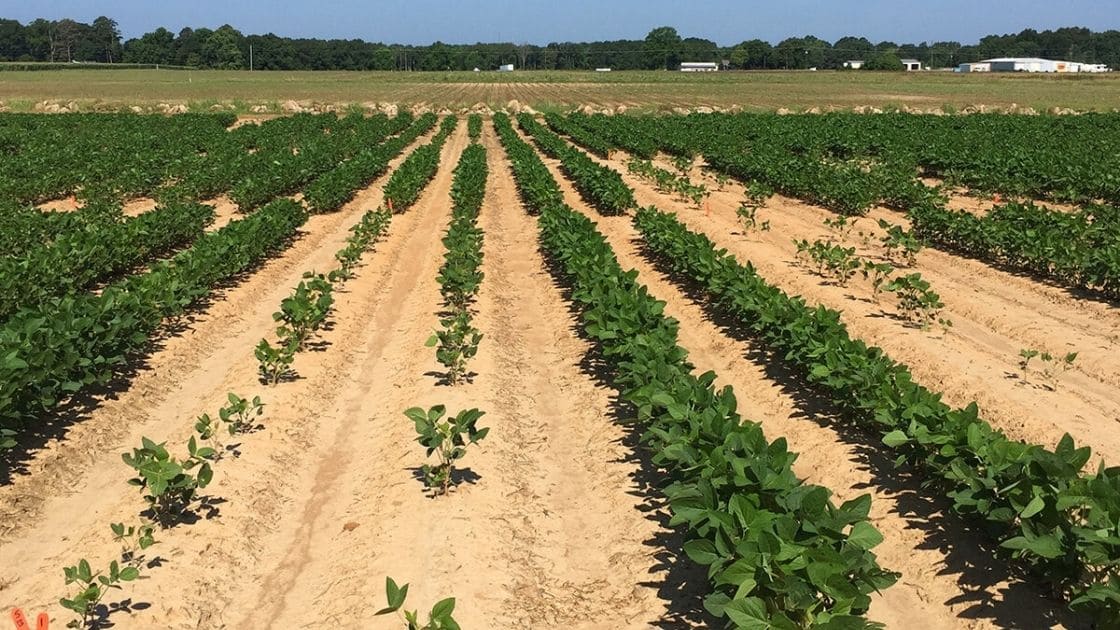
Louisiana farmers rely on herbicides, pesticides and fungicides to protect their crops against weeds, insects and diseases. Even though most farmers try to be good stewards of the environment, some of those chemicals inevitably end up in waterways, or elsewhere, instead of benefiting the plants. To address this problem, LSU Professor Cristina Sabliov is working on technologies for more targeted delivery of agrochemicals to crops, to prevent waste—a cost issue for farmers—while protecting plants, yields and the environment. Sabliov develops nanoparticles that are smaller than the eye can see—about a thousand times smaller than the thickness of a human hair. These tiny delivery systems can attach to specific parts of a plant, such as the root or the leaves, and deposit a small but significant payload to be released either immediately or over time.
Most of Sabliov’s work to-date has focused on soybeans, a major crop in Louisiana and around the world. She’s received continuous support for her research from the Louisiana Soybean and Grain Research and Promotion Board and from the U.S. Department of Agriculture throughout her career. “Louisiana soyabean farmers see great value in supporting research that can generate solutions to challenges that are unique to our state,” said Charles Cannatella, chairman of the Louisiana Soybean and Grain Research and Promotion Board and a farmer in Melville in St. Landry Parish where he grows soybeans, corn and sugarcane together with his family. “We are excited that Dr. Cristina Sabliov is doing just that. Louisiana soybeans thrive in large part due to our climate conditions, which also present unique challenges, like diseases and fungi that thrive in these same conditions.”
Many Louisianans are surprised to learn that their home state produces more soybeans than rice. Soybeans rank fourth among Louisiana’s top agricultural commodities, after forestry, poultry and sugarcane. At harvest, 80% of all soybeans become soya bean meal, often used as livestock feed since it’s high in protein. Most of that meal is fed to chickens, so the argument could be made that Sabliov’s research supports not just one, but two, of the state’s top agricultural industries. Her most recent work turns a waste product from the paper industry called lignin into something useful as biodegradable “nano vehicles.” Lignin is present in most plants to give cells rigidity. Without lignin, trees would be floppy and sag. This natural polymer is both cheap and safe. Through advanced engineering and chemistry, Sabliov and her team are able to wrap lignin molecules around other materials, such as agrochemicals. By using surfactants, they can keep the compounds homogeneously dispersed, similar to a vinaigrette that never separates, and then dry the resulting nanoparticles into a powder, extending their shelf life.