

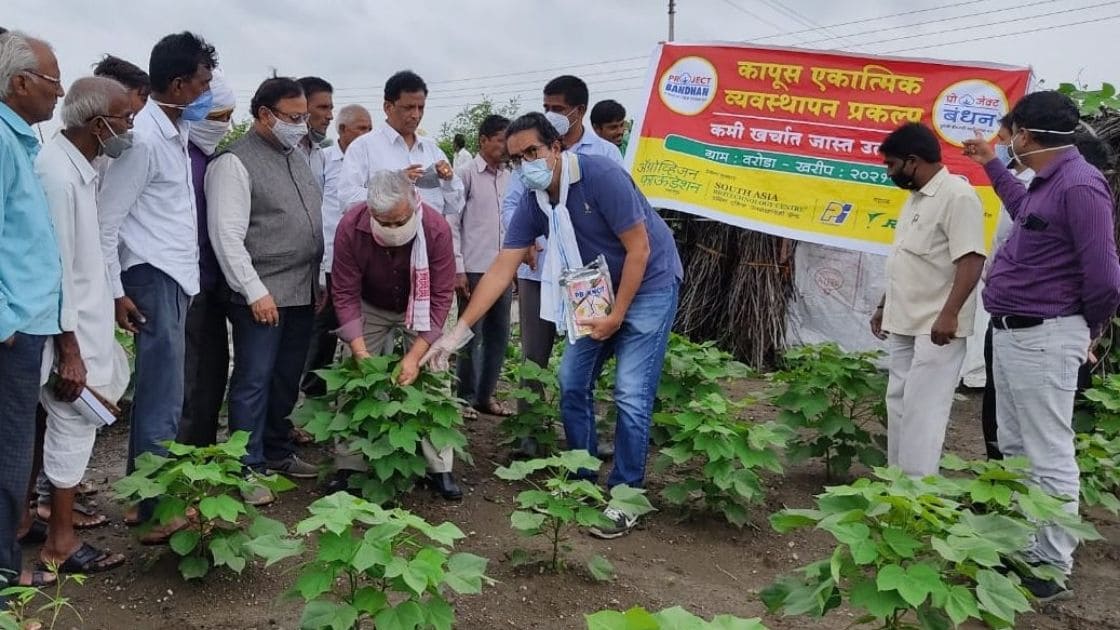
The field experiment laid out over 300 acres of cotton fields with the structured tagging of PBKnot thread under the guidance of experts from SABC, Agrovision Foundation and ICAR-CICR.
The South Asia Biotechnology Centre (SABC), Jodhpur in collaboration with Agrovision Foundation, Nagpur has laid out India’s largest field experiment of an innovative mating disruption or mating confusion technology spread over 300 acres in four clusters to ward off a devasting pest pink bollworm (PBW) in the cotton crop in Waroda and Adasa villages in Kalmeshwar Taluka in Nagpur district of Maharashtra.
PBKnot is an innovative mating disruption technology, approved recently by the Central Insecticides Board and Registration Committee (CIBRC) of the Ministry of Agriculture & Farmers Welfares, Government of India is an ideal approach for effective PBW management and the best fit in IPM of bollworm management in cotton. Moreover, PBKnot technology is easy in application, safe to beneficial insects and eco-friendly.
A first-of-its-kind field experiment laid out over 300 acres in four clusters in GPS coordinated cotton fields with the structured tagging of PBKnot thread by trained local volunteers under the guidance of experts from South Asia Biotechnology Centre (SABC), Agrovision Foundation and ICAR- Central Institute for Cotton Research (CICR) will be studied for pest insect population dynamics, insect ecology and damage as part of integrated pest management (IPM) approach of pink bollworm.
Pink Bollworm – a mysterious pest, has hit cotton growers hard in Maharashtra in Kharif during 2020-21. There has been a noticeable increase in PBW infestation in Gujarat, Maharashtra, Telangana and Andhra Pradesh and recently in northern cotton growing belt. Though large scale Bt-cotton cultivation provides inbuilt protection against notorious American bollworm (Helicoverpa armigera), the emergence of PBW has become the new enemy of cotton farmers. While Helicoverpa infestation resulted in definite yield loss, PBW infestation primarily affects the lint quality, though its early occurrence may even lead to a reduction in yield and significant losses.
“We have laid out the country’s largest field experiment by tagging cotton plants with PBKnot in such a way that PBKnot charges the surrounding air with Gossyplure, a pheromone scent that confuses the male adults preventing them for finding and mating with female adults and reduces the number of eggs laid and PBW population in subsequent generations. Interestingly, PBKnot releases the same scent that female PBW releases to attract males for mating,” said Dr CD Mayee, President, South Asia Biotechnology Centre (SABC), Jodhpur.
“Mating confusion – a disruptive pheromone-based technique, is now available in the form of the solid metric dispenser rope known as PBKnot and can be easily applied to the cotton plant at the pin head square stage over the minimum area of 60 to 64 acres in contiguous basis. The PBKnot can protect cotton plant for 90 days in the crucial time of flowering, boll formation up to boll maturity and hence reduce boll damage, improve quality and increase cotton yield”, said Bhagirath Choudhary, Director, South Asia Biotechnology Centre (SABC). The outbreak of pink bollworm in 2020 was a wake-up call. Field-based solution of rolling out PBKnot technology is an extension of our efforts to help cotton growers in Vidarbha to manage pink bollworm in Kharif 2021, elaborated, Dr Choudhary.