

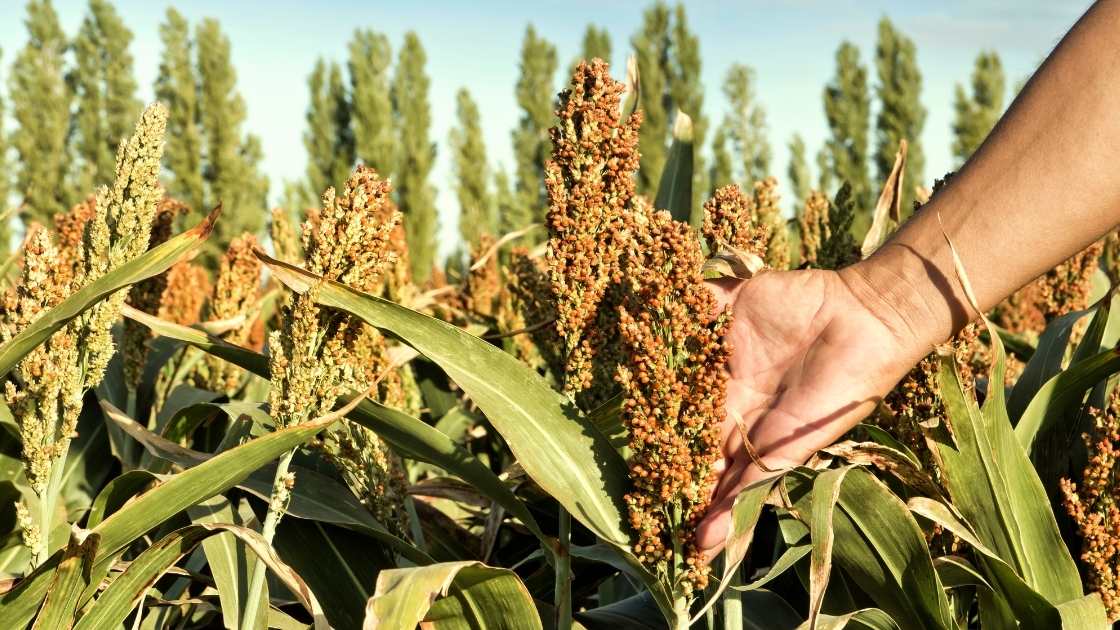
The study, “Bioenergy sorghum’s deep roots: A key to sustainable biomass production on annual cropland,” was recently published in GCB Bioenergy.
According to the research, bioenergy sorghum hybrids capture and sequester significant amounts of atmospheric carbon dioxide in soil. The crop can improve soil fertility and potentially earn carbon credits to offset greenhouse gas emissions.
In addition, the study shows that bioenergy sorghum’s unusually deep root system can reach sources of water and nutrients untapped by other annual crops. These results suggest the crop can help manage fertilizer runoff from other annuals in a crop rotation.
Scientist have been working to improve bioenergy sorghum varieties to produce an ideal annual bioenergy crop. The hybrid used in the recent study creates high yields of biomass for fuel, power and bioproduct generation. The crop also has excellent drought resilience, good nitrogen-use efficiency and a deep root system.
“There is an assumption that the most sustainable bioenergy crops are perennial because they require fewer inputs and can sequester more biomass than annuals,” said by an official.
The study shows that an acre planted with a bioenergy sorghum hybrid accumulates about 3.1 tons of dry root biomass over the crop’s 155-day growing season. Bioenergy sorghum roots also grew to over 6.5 feet deep over their growing season.
These new metrics make it easier to predict how much atmospheric carbon dioxide might be captured inside roots. The numbers can also shed light on how many carbon credits a planted field might earn.
The numbers are also important for understanding the crop’s potential to improve soil fertility and water-holding capacity by replenishing soil organic carbon. However, previous research has shown that soil organic carbon levels have fallen by 50% over the past 100 years in land planted with annual crops.
This drop in soil carbon levels could be due to cropping practices, microbial activity and changing land use, Rooney said. These complex factors mean that predicting how long it might take to replenish lost carbon requires sophisticated modeling. The restoration process is likely to take many decades.
In this study, one of the team managed the field trials and helped with phenotyping while, the other team characterized the root system and the genes expressed within.
Over multiple years, the study considered in-depth how one bioenergy sorghum hybrid interacts with two soil types. He stresses the need to conduct further research.
“In this study, they didn’t sample the genetic diversity of bioenergy sorghum at all, except for one standard type,”. “And looking at multiple environments and expanding the range of they were evaluating is essential.”
Modeling studies estimate that millions of acres of abandoned and marginal cropland are available for planting. The region is ideal for bioenergy sorghum production because of ample rainfall, long growing seasons and low competition with grain crops. Furthermore, the crop has improved over the years in terms of productivity, resilience and composition.
Carbon captured in biofuels and bioproducts at biorefineries, and by bioenergy sorghum roots could generate carbon credits, potentially benefiting producers and industry.
Scientist are now working to attract industry and government funding to help build the next generation of biorefineries designed to use bioenergy sorghum biomass for the production of biofuels, bioproducts and biopower.
“The project has expanded to not just producing biofuels and bioproducts, but also directly capturing carbon and sequestering it,”.
Created By :- Banirupa Patra